

Immune Resilience Starts Before You Get Sick

They treat it like something that turns on when there’s a problem — something to react to once symptoms show up, energy drops, or the body starts signaling that something is off.
That thinking made sense when people assumed there would always be a reliable backstop — prescriptions, antivirals, antibiotics — a system designed to manage illness after it appears, not to ensure the body is prepared before it does.
But that assumption is getting weaker.
In recent years, access to common medications — including antivirals like Tamiflu and widely used antibiotics — has become less predictable during peak illness periods. In some cases, patients have experienced delays or limited availability for medications that were previously accessible on the same day. Pharmacies across the U.S. continue to report shortages tied to supply chain disruptions, manufacturing delays, and sudden spikes in demand.
At the same time, treatment-resistant bacteria and viruses continue to rise, making some medications less effective than they once were.
The safety net people relied on is no longer as predictable as it once was.
And that shifts the burden.
Because when access is delayed or uncertain, your immune system isn’t something you can afford to think about after the fact. It becomes your first line of defense, whether it’s ready or not.
That’s where the real problem shows up.
Most people are still operating as if they can deal with their health when the time comes. But when you layer in chronic stress, poor sleep, nutrient gaps, low sunlight exposure, and the constant demands placed on the immune system — you don’t build resilience in the moment, you reveal it.

That’s the shift.
You don’t control what you’re exposed to.
You don’t control whether medications are readily available when you need them.
You don’t control how quickly you can access care.
But you do control whether your body has consistent, daily support; the nutrients, habits, and inputs it needs to function at a high level.
A resilient immune system isn’t built in response to a problem.
It reflects the work done long before exposure ever happens.
Not as a reaction. As a foundation.

Your immune system isn’t a switch you flip on when something goes wrong.
It’s a coordinated biological defense network, constantly working in the background, relying on multiple systems and consistent inputs to function effectively.
At a high level, it operates through two complementary responses:
Innate Immunity (Immediate Defense)
Your first line of defense. It reacts quickly and broadly to anything unfamiliar.
Adaptive Immunity (Targeted Response)
Slower to activate, but highly specific. It builds memory and improves response over time.
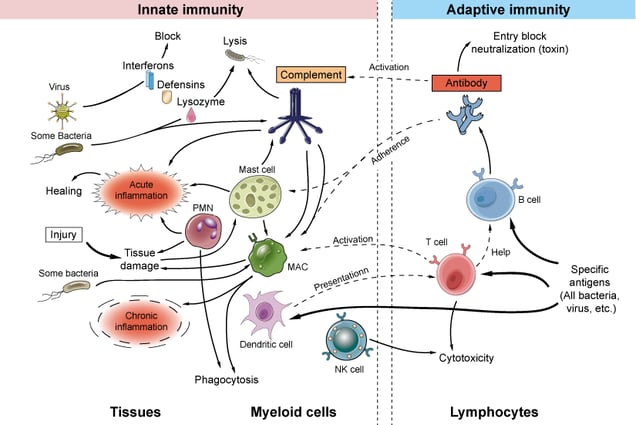
Source: Creative Diagnostics, “Innate and Adaptive Immunity”
Both are essential. Both systems rely on adequate resources.
When nutrient intake is insufficient, sleep is inconsistent, stress is elevated, or inflammation remains high, immune performance doesn’t collapse — it degrades.
Slower response.
Less coordination.
More strain on the system.
Not because your body is broken. Because it’s under-supported.
Biology is remarkably resilient, but it’s also resource-dependent.
This is why searches for “how to strengthen the immune system naturally” and “best vitamins for immune support”continue to rise.
Where people get this wrong is thinking they can fix it in the moment. They throw everything at the problem and hope it’s enough.
But immune resilience is built on consistency — the daily inputs that determine how your body performs when it matters most.
IDLife Supports Preparation - Not Reaction

IDLife approaches immune support differently.
Not as a short-term solution when something goes wrong, but as a wellness system designed to support immune health daily before it’s put under pressure.

Immune Defense was formulated with clinically studied nutrients and botanicals selected to support both innate and adaptive immune function; not in isolation, but in a way that reflects how the immune system actually operates.
No shortcuts.
No unnecessary complexity.
Just targeted, daily immune system support.
This isn’t about hype or quick fixes.
It’s about giving your body the resources it needs to perform.
Why the Formula Works
Immune resilience isn’t driven by a single pathway, and it isn’t supported by a single ingredient.
It’s the result of multiple systems working together: signaling, responding, regulating, and recovering in coordination.
That’s how this formula was built.
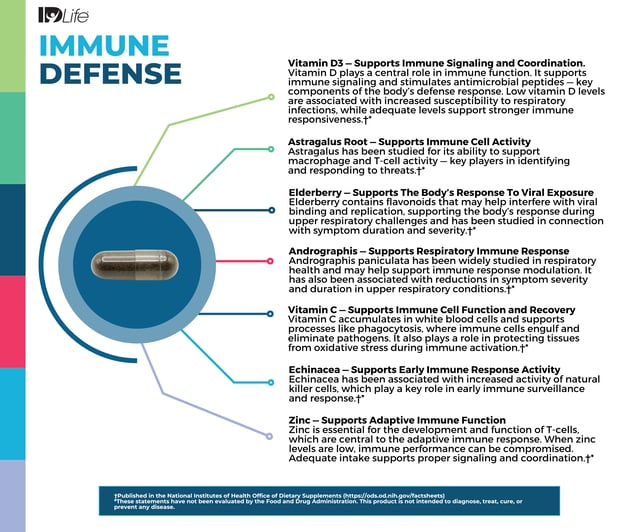
Why Combination Support Matters
Many people search for a single “best immune supplement.”
But immune resilience doesn’t come from one ingredient trying to do everything. It’s the result of multiple systems working together — regulating, signaling, responding, and recovering in a coordinated way.
That’s why focusing on one “hero” nutrient misses how the immune system actually operates:
Vitamin D helps regulate immune signaling.
Vitamin C supports immune cell activity.
Zinc coordinates adaptive response.
Botanicals support readiness and response.
Each contributes something different, and none are designed to work in isolation.
That’s why combination support works — because it reflects how the immune system actually functions.
Not one pathway.
A system.
Immune Health Isn’t Seasonal
Most people think about immune support only when something is going around.
But immune health is influenced year-round by:
• Nutrient status
• Sleep quality
• Stress levels
• Sunlight exposure
• Gut health
• Inflammation
Which makes the traditional approach backwards.
If immune support only becomes a priority when risk increases, you’re already behind. Because resilience isn’t built in a season, it’s built in the months leading up to it.
What Happens if You Do Nothing
If immune health stays reactive, you’re left relying on:
Waiting for symptoms
Assuming medications will be available
Hoping your body responds well under pressure
That’s not a strategy.
It’s a gamble.
Because when the moment comes, your body doesn’t rise to the occasion.
It falls back on the foundation you’ve built.
The Bottom Line
You don’t control exposure.
You don’t control medication availability.
You don’t control timing.
But you do control whether your immune system is supported before it’s tested.
Immune Defense was designed to provide that support — consistently, daily, and in a way that aligns with how your body actually works.
Because the best time to support your immune system isn’t when symptoms start.
It’s before.
Take The Next Step
The decision isn’t complicated.
You can keep approaching immune health reactively — waiting until something feels off and hoping everything you need is there when it happens.
Or you can start building the foundation your body relies on before it’s needed.
Start with the Immune Support Pack — a simple, daily way to help support your immune system with targeted nutrients designed to work together.
For a more personalized and comprehensive approach, take the IDNutrition Assessment to identify your unique micronutrient needs and build a system tailored specifically to you.
Because when your body is under pressure, it doesn’t rise to the moment.
It falls back on what you’ve already built.
References
- Jolliffe, D. A., et al. (2017). Vitamin D supplementation to prevent acute respiratory tract infections: systematic review and meta-analysis of individual participant data. The BMJ.
- Li, X., et al. (2023). The effect of Astragalus on humoral and cellular immune response: A systematic review and meta-analysis of human studies. Complementary Medicine Research.
- Hawkins, J., et al. (2019). Black elderberry (Sambucus nigra) supplementation effectively treats upper respiratory symptoms: A meta-analysis of randomized controlled clinical trials. Complementary Therapies in Medicine.
- Hu, X. Y., et al. (2017). Andrographis paniculata for symptomatic relief of acute respiratory tract infections: A systematic review and meta-analysis. PLoS One.
- Hemilä, H., & Chalker, E. (2013). Vitamin C for preventing and treating the common cold. Cochrane Database of Systematic Reviews.
- Schapowal, A., et al. (2015). Echinacea reduces the risk of recurrent respiratory tract infections and complications: A meta-analysis of randomized controlled trials. Advances in Therapy.
- Hemilä, H. (2017). Zinc lozenges and the common cold: A meta-analysis comparing zinc acetate and zinc gluconate. JRSM Open.
- Maggini, S., et al. (2012). A combination of high-dose vitamin C plus zinc for the common cold. Journal of International Medical Research.
-
Creative Diagnostics. (n.d.). Innate and adaptive immunity. Creative Diagnostics. https://www.creative-diagnostics.com/innate-and-adaptive-immunity.htm

Share Your Thoughts!